The Copy-Paste Investigation into COVID Origins
Ridley’s Viral mirrors the lab leak investigation in part of the intelligence community: copy and paste arguments from the Internet, become more confident when they're debunked, and return to the same sources for more.
Today, the National Institutes of Health (NIH) is hosting Matt Ridley to deliver a lecture titled "Viral: The Search for the Origin of COVID-19" as part of its "Scientific Freedom" series. In the book Viral, Ridley promoted the theory that the Wuhan Institute of Virology conducted "secret pangolin research" before the pandemic. He speculated that SARS-CoV-2 was created by accident in recombination experiments with "the novel spike RBD [Receptor Binding Domain]" from smuggled pangolins. Ridley isn't likely to talk much about that today, because that theory was disproven in September 2021:
"With the new viruses described here, understanding the emergence of SARS-CoV-2 does not require speculation of recombination or natural selection for increased RBD affinity for hACE2 in an intermediate host such as the pangolin before spillover, nor natural selection in humans following spillover." Temmam et al. 2022 (preprinted September 2021)
This work proved that the bat origin of the SARS-CoV-2 RBD, showing that theories invoking a "novel spike" very different from anything found in bat viruses were wrong.
Ridley is well aware—he deleted "novel spikes" out of the second edition of his book and perhaps hoped no one would notice [[2]]. During the editing process, his co-author Alina Chan had asked writer Eve Fairbanks if she should make the book "less scientific but more impactful?"
Despite that theory being disproven, today Ridley is more certain than ever that SARS-CoV-2 came from a lab: "This is extraordinary and brilliant work. The case for the lab leak is now far beyond reasonable doubt." Who is Ridley crediting with the insight that clinched the case? It's Yuri Deigin: exactly the same person responsible for the "secret pangolin research" hypothesis! What qualifies Deigin to be a trusted source after making a bad bet against evolution the first time? Absolutely nothing. Yet, early 2020 work by Deigin and his co-author Rossana Segreto [[3]] profoundly influenced not only Viral, but also the United States intelligence community, where it was plagiarized by researchers.
[[2]]: First edition: "they had also delineated a workflow for identifying novel cleavage sites and inserting these into novel spikes and novel SARS-like viruses in the lab."
Second edition: "they had also delineated a workflow for identifying novel cleavage sites and inserting these into novel SARS-like viruses in the lab."
This isn't the only edit of this type or the most significant one. It's just the one most relevant to this story.
[[3]]: "The genetic structure of SARS-CoV-2 does not rule out a laboratory origin." Segreto & Deigin 2020
Please do not read this without also reading the critique from Alexander Tyshkovskiy and Alexander Y. Panchin, which only scratches the surface of how flawed Segreto & Deigin's paper was.
Yet, early 2020 work by Deigin and his co-author Rossana Segreto profoundly influenced not only Viral, but also the United States intelligence community, where it was plagiarized by researchers.
The "Suppressed" Intelligence that was Actually Plagiarized
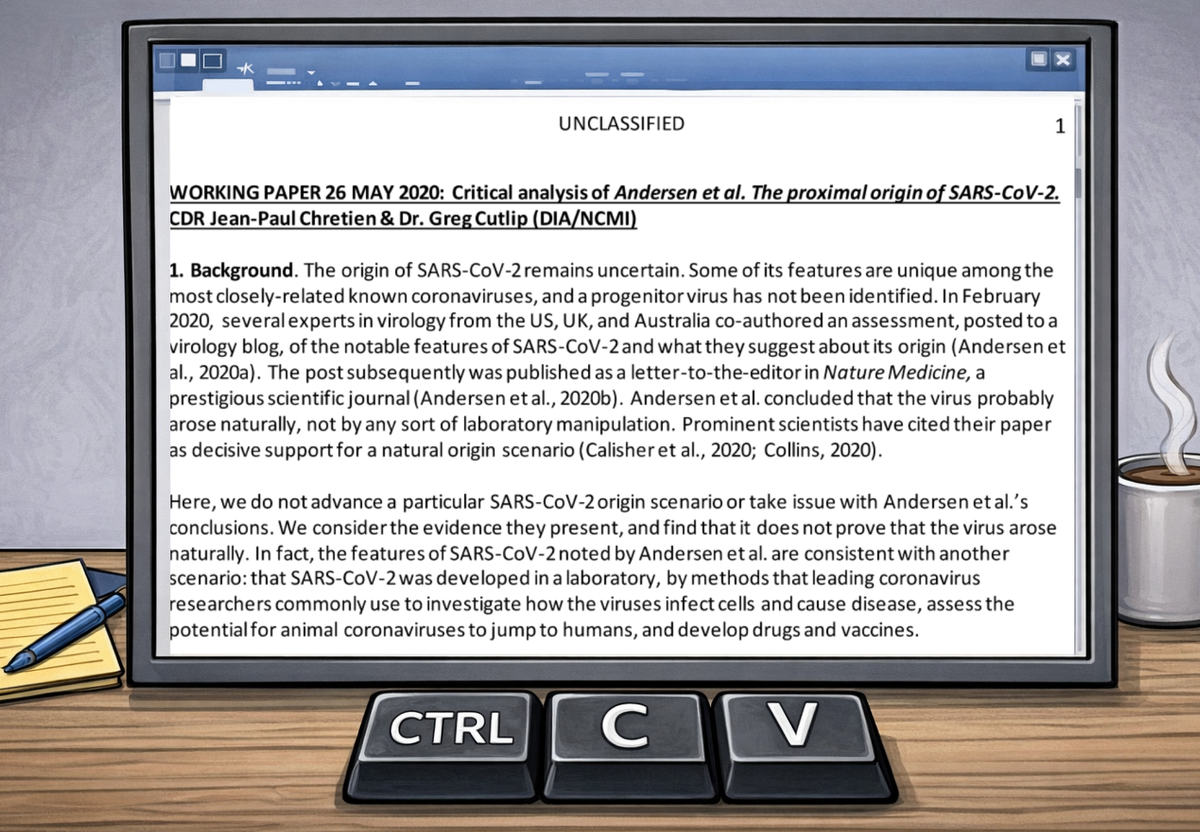
Major media outlets, including the Wall Street Journal, have published stories portraying scientists at the Defense Intelligence Agency's National Center for Medical Intelligence (NCMI) as brave "spy-world" sleuths whose vital intelligence concluding that COVID-19 was manipulated in a lab was unjustly suppressed in the Intelligence Community’s 90-day review on the origins of COVID-19. Their unclassified May 26, 2020 working paper was wielded in Congress to push back on the consensus in scientific publications of a natural origin. In July 2023, Rep. Brad Wenstrup asked scientists Kristian Andersen and Robert Garry to defend a 3-year-old paper they'd co-authored against "the work of Dr. Jean-Paul Chretien and Dr. Greg Cutlip for their more comprehensive and detailed approach that we see from their scientific report."
I think it's unlikely that Rep. Wenstrup knew that the "comprehensive and detailed approach" taken by Chretien and Cutlip in writing the report was little more than plagiarism of Rossana Segreto and Yuri Deigin [[4]].
[[4]]: Note that although Segreto & Deigin's paper was first published in November 2020, preprint versions of plagiarized texts were available weeks before the May 2020 date of the NCMI working paper. Quotes are from preprints.
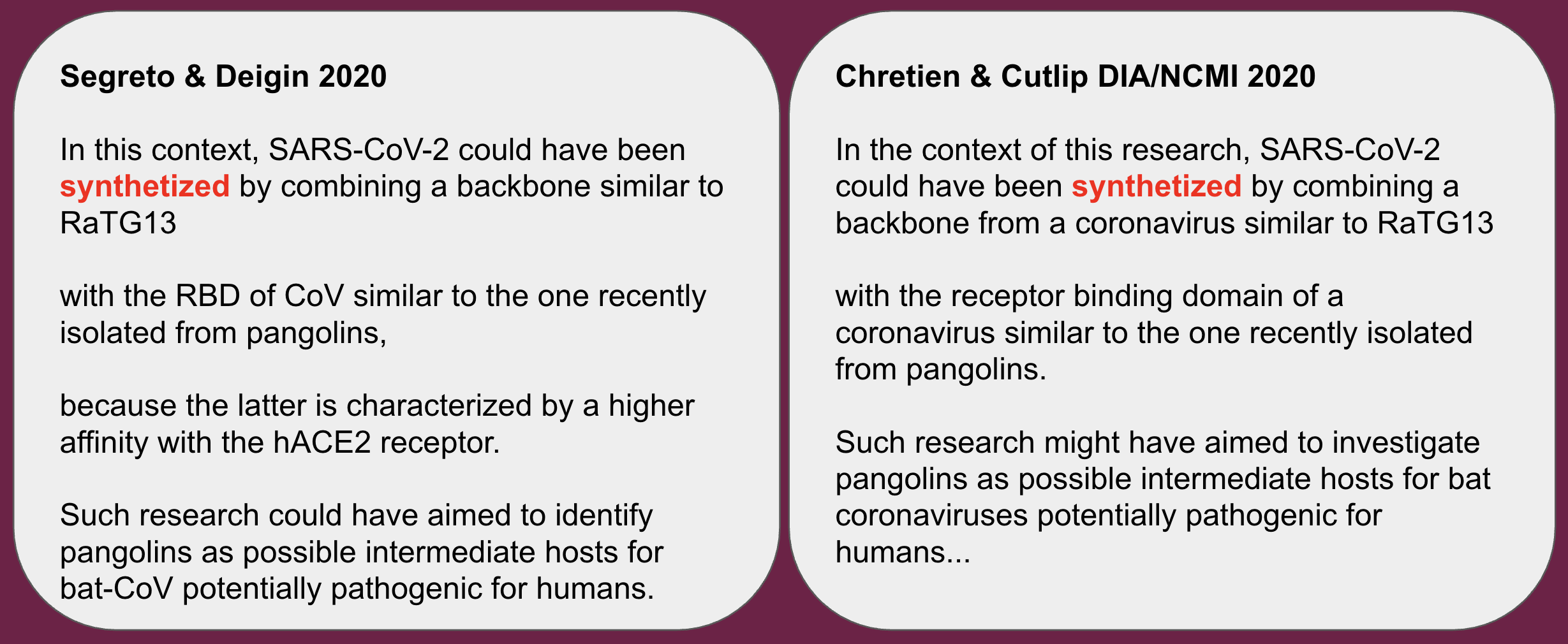
Side-by-side comparisons reveal that the military intelligence analysis was essentially a copy-paste job of Segreto and Deigin's work, which was never cited. Here are some examples in Chretien & Cutlip's working paper (click the notes to compare the texts):
- Both texts hypothesize that SARS-CoV-2 could have been "synthetized" by combining a bat backbone with a pangolin receptor-binding domain. The NCMI authors copied the misspelled word "synthetized" directly from the source, showing that the text was lifted word-for-word. (This is the exact same "secret pangolin research" theory that I suspect Matt Ridley will avoid talking about today).
- Both speculate, word-for-word, that "Pangolins, or other animals with similar ACE2 conformation, could have been used" in lab experiments without checking to see if controlled virological experiments are common with pangolins in captivity (they are not). [[5]]
- Both provided identical explanations for why no evidence has emerged for pre-pandemic work with SARS-CoV-2: maybe the experiments were "aborted" because of the SARS-CoV-2 outbreak and, if not, maybe the experiments were always meant to remain secret. [[6]]
- Both have identical rationalizations for why SARS-CoV-2 would have been engineered without using previously published genetic components. [[7]]
In a June 2023 Congressional interview, Jean-Paul Chretien was asked about his working paper, "Can you explain how that particular virus doesn't rule out a laboratory-based scenario?" He responded with the theory that he had plagiarized from Segreto and Deigin three years earlier; the theory already proven wrong in 2021 ("the emergence of SARS-CoV-2 does not require speculation of recombination"):
Yes. So one of the – the scenarios we laid out as plausible, and I think would still be plausible [NB: this is not plausible], is to begin with a bat origin coronavirus, something along the lines of RaTG13 but more similar to the – or very, very closely similar to SARS-CoV-2, and then – and then evaluate the effects of inserting a receptor-binding domain from another species, such as a pangolin. And that's consistent with work that we've seen published from various coronavirus research labs and would be consistent with the observed SARS-CoV-2 as well.
[[5]]: Segreto & Deigin: "Nevertheless, while it is true that O-linked glycans are much more likely to arise under immune selection, they could be added in the lab through site-directed mutagenesis or arise in the course of in vivo experiments... Pangolins or other animals with similar ACE2 conformation could have been used as experimental animals as well."
Chretien & Cutlip: "O-linked glycans... typically arise under immune selection, which would not occur in cell culture. However, the glycans could have arisen in animal, rather than cell culture, experiments. ...Pangolins, or other animals with similar ACE2 conformation, could have been used in such in vivo experiments."
[[6]]: Segreto & Deigin: "It should not be excluded that such experiments could have been aborted due to the SARS-CoV-2 outbreak, before a possible publication of the results or that the results were never intended to be published."
Chretien & Cutlip: "Perhaps the experiments were aborted or not reported because of the SARS-CoV-2 outbreak? Perhaps the results were never intended for publication?"
[[7]]: Segreto & Deigin: "In the last six years before the outbreak of SARS-CoV-2 the number of potential bat backbones has been undeniably increased by several bat CoV screenings... Other possible backbones could, as well, still wait for publication."
Chretien & Cutlip: "... the lack of a published report does not mean that the study was not performed. In the 6 years before the COVID-19 outbreak, the number of potential bat SARS-like CoV backbones has increased with coronavirus discovery efforts... "
Plagiarists Plagiarizing Plagiarists
As if military intelligence professionals copy-pasting internet preprints and appearing before Congress without checking the scientific literature wasn't bad enough, Segreto and Deigin's paper was itself a product of plagiarism and fabrication.
Segreto and Deigin's paper was itself a product of plagiarism and fabrication.
Not only was text lifted verbatim from multiple sources, the text was then doctored to suppress the evidence that undermined their theory.
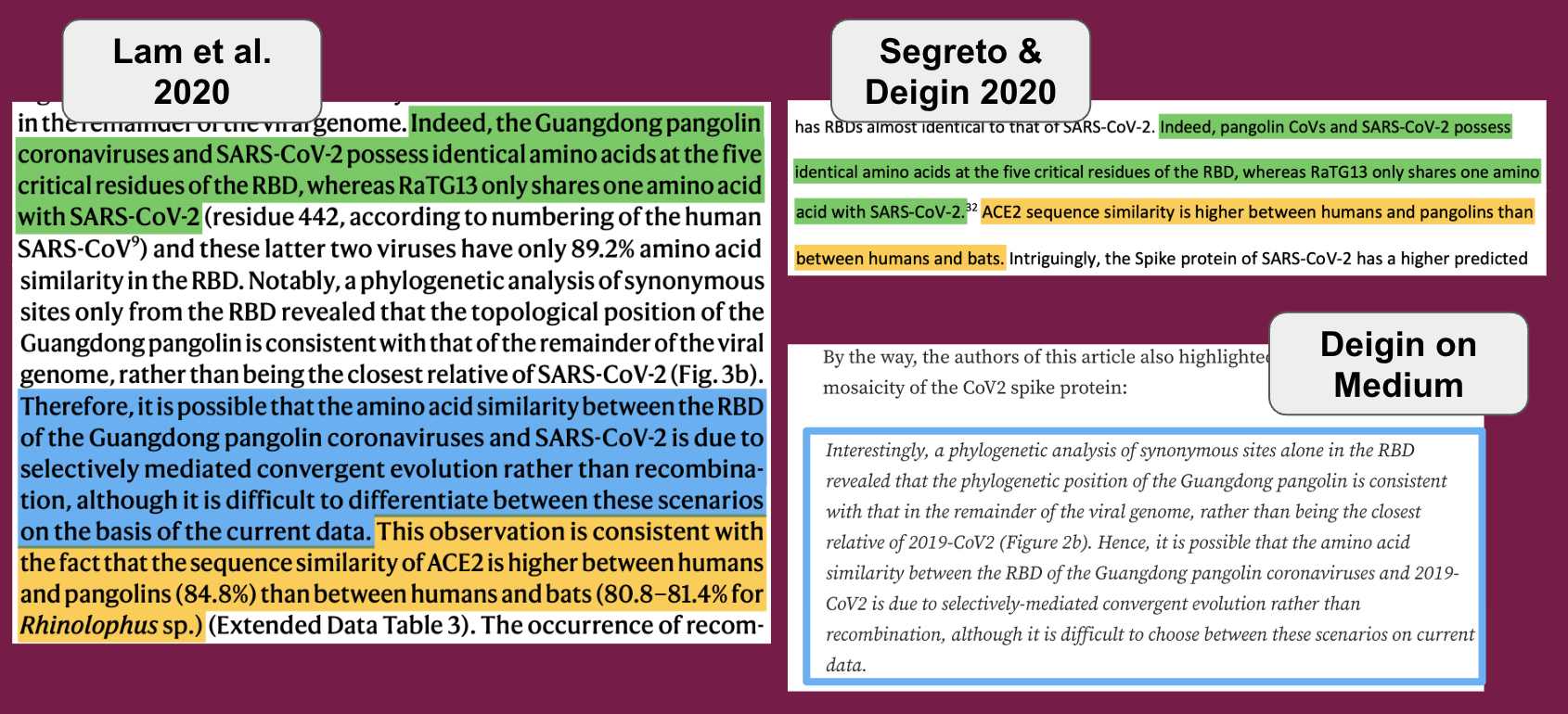
In one instance, Segreto & Deigin borrowed two sentences from a paper reporting a pangolin coronavirus, but skipped the sentence in between that considered whether "the amino acid similarity between the RBD of the Guangdong pangolin coronaviruses and SARS-CoV-2 is due to selectively mediated convergent evolution rather than recombination." This alternative hypothesis, one likely to be correct, was never mentioned in their paper.
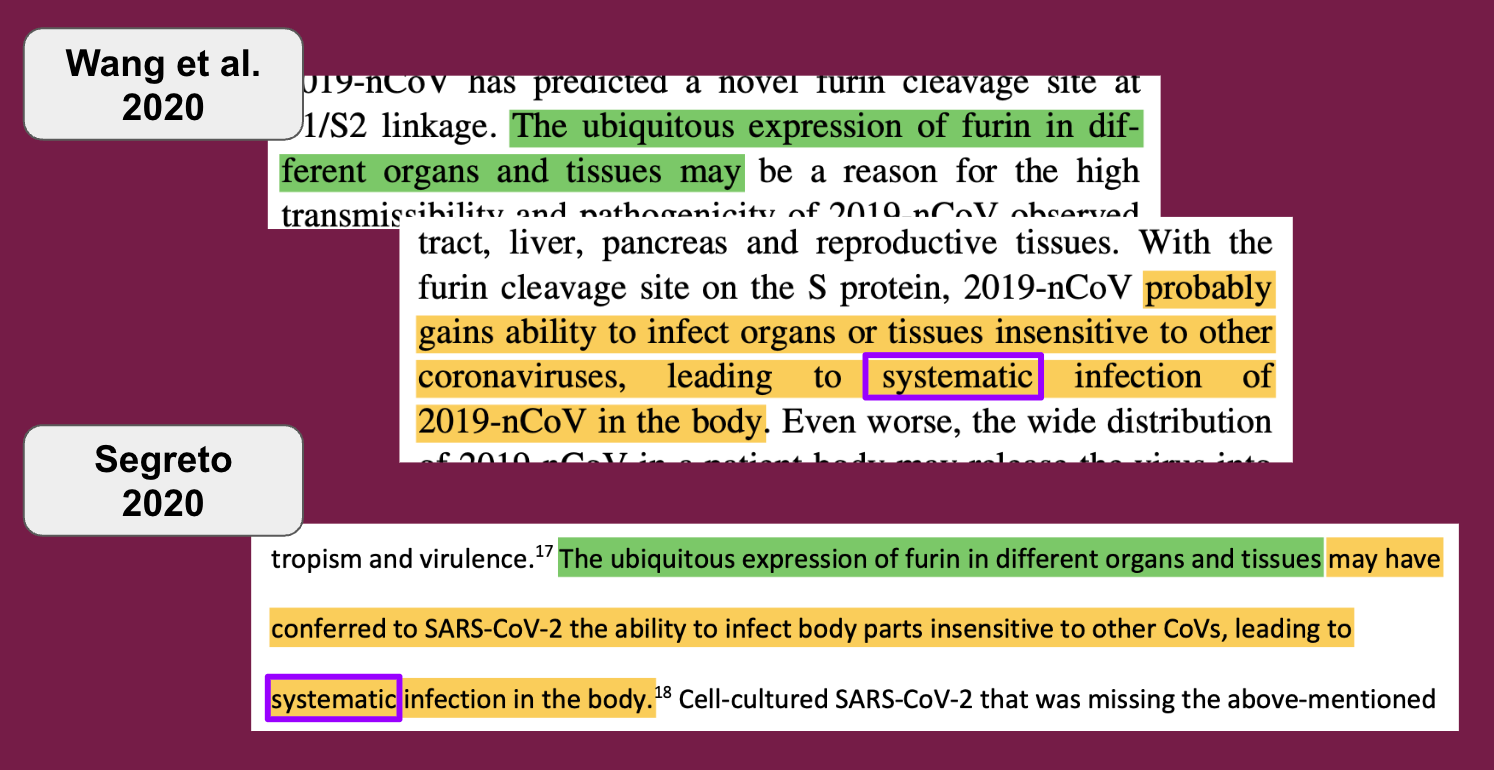
In another example, Segreto & Deigin borrowed a statement about SARS-CoV-2's "ability to infect organs or tissues insensitive to other coronaviruses, leading to systematic infection of 2019-nCoV in the body." And the error of writing "systematic" rather than "systemic" was included in an early version of the paper:
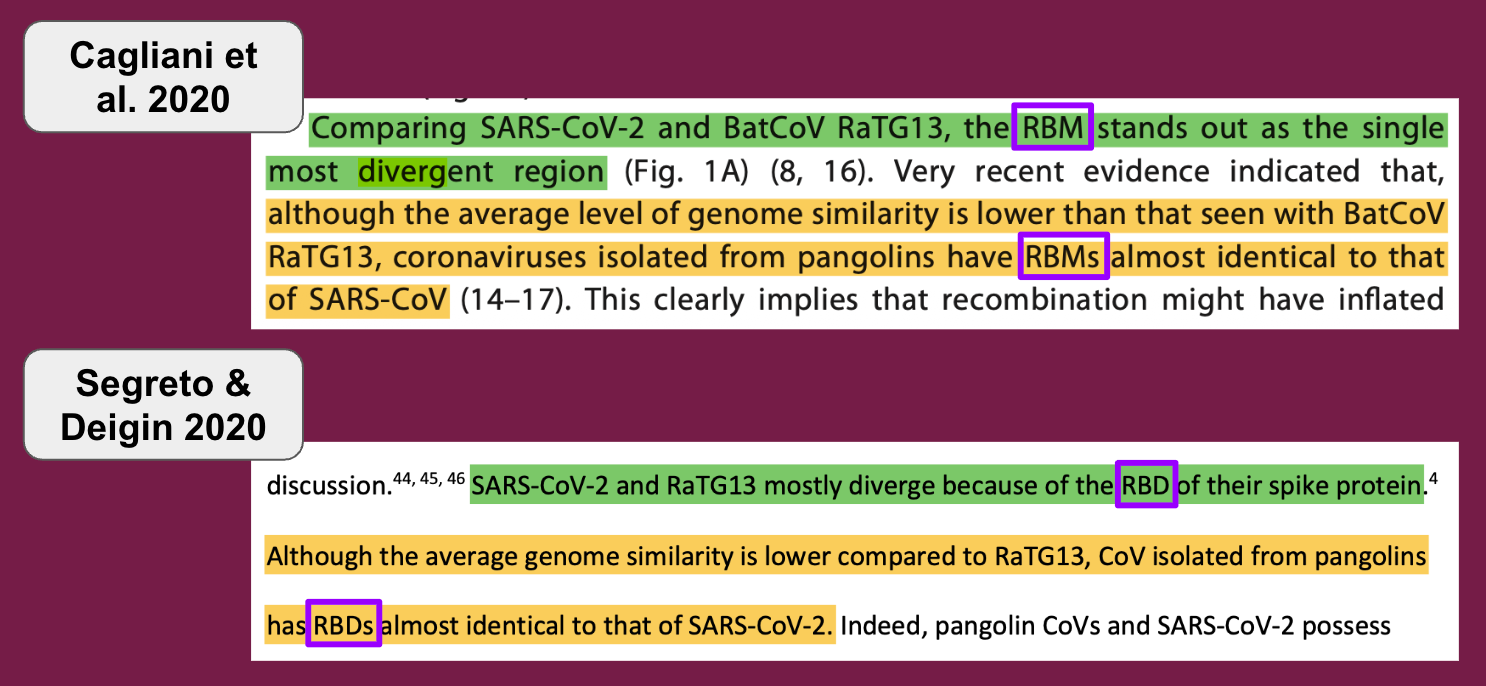
In this last example, the only significant change is to doctor the plagiarized text to replace "RBD" with "RBM":
To explain the significance of this manipulation, I will quote Yuri Deigin himself:
- The RBM is just a part of the RBD. Deigin: "the place where [the S1 domain of Spike binds Ace2] is called Receptor Binding Domain (RBD), while the area of direct contact, the holy of holies, is called Receptor Binding Motif (RBM)."
- The RBM, not the surrounding sequence, is where the pangolin virus is more similar to SARS-CoV-2 than RaTG13. Deigin: "in the RBM, the pangolin strain is closer to CoV2 than is RaTG13, but it is RaTG13 that is closer to CoV2 to the left and right of RBM."
So, the papers cited by Segreto & Deigin refer to possible recombination of the RBM, but Segreto & Deigin changed this to RBD.
Why the change? Because Segreto & Deigin have a section called "CREATING CHIMERIC COVS WITH NOVEL RBDS HAS GONE ON FOR DECADES." [[9]] There is some precedent for successful experiments making chimeric viruses by swapping the RBD. There is also precedent for attempting to swap only the RBM. It did not work. So to make a tight story, Segreto & Deigin simply took someone else's words and changed the inconvenient ones.
[[9]]: "DECADES" is also wrong.
If you think perhaps it's reasonable that Chretien & Cutlip were duped given that the plagiarism and text manipulation aren't obvious, please consider Figure 2 from Segreto & Deigin, which they say shows that "no insertions are apparent, just nucleotide mutations" separating coronaviruses RmYN02 and ZC45 in this picture: [[10]]
[[10]]: I've avoided discussing the second half of their story so far and it's no more compelling than the first half. The point of this statement is to claim that novel sequences in the blue part of the figure are vanishingly rare, and thus the novel sequence in SARS-CoV-2 is suspicious. God of the gaps.
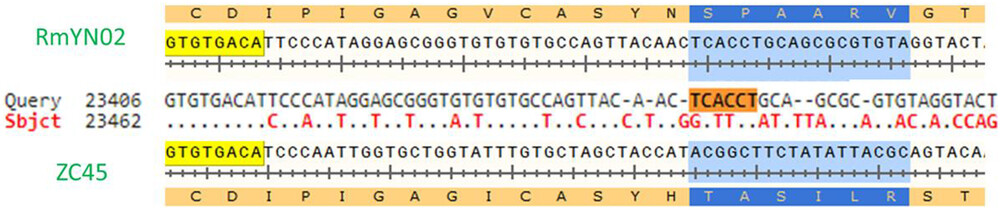
See all of the red letters in the middle? These are mismatches. See the dashes in the line above them? These are gaps in the sequence alignment. These two sequences, in this region, are not closely related, and they clearly differ by more than "just nucleotide mutations" (i.e. they have different histories of insertion, deletion, and/or recombination as well).
This is just one example of the kinds of clumsy and obvious falsehoods that wowed Matt Ridley and some circles of the US intelligence community. Tune in to Ridley's lecture today if you want to hear an updated version of more of the same. Or tune in to a real-time commentary from Angela Rasmussen, Kristian Andersen, and Gigi Gronvall.
Low Standards
Did the DIA analysts have good reason to put their faith in Segreto and Deigin's analysis without fact-checking the details? I've found nothing in their work on this subject that projects credibility. Long before Chretien's Congressional interview, Segreto wrote up her hypothesis that SARS-CoV-2 spread to China from the United States, where it might've been causing COVID-19 as far back as 2017 misdiagnosed as EVALI (a vaping-associated lung condition). Yuri Deigin argued on Twitter that the 2014 West African Ebola outbreak was also a lab leak, a baseless argument, proven false, that took off when two people decided to exploit people who died in Sierra Leone to harass scientists elsewhere in the world.
This lack of credibility should also have been obvious to anyone reading Segreto & Deigin's paper in BioEssays. The very first citation is to a paper by Sirotkin & Sirotkin, also in BioEssays, that more or less gets every major fact it mentions wrong. This is not surprising as neither Sirotkin appears to have any relevant expertise. [[11]]
[[11]]: The less said about Dan Sirotkin here, the better. He says it for himself on his LinkedIn page if you want to know.
Yet, the papers by Segreto & Deigin and Sirotkin & Sirotkin both figured prominently in government investigations. According to a document called "chart for sources of Covid origins" circulating in the Department of State, these BioEssays articles were the only two nominally peer-reviewed sources arguing for a lab origin of COVID-19.
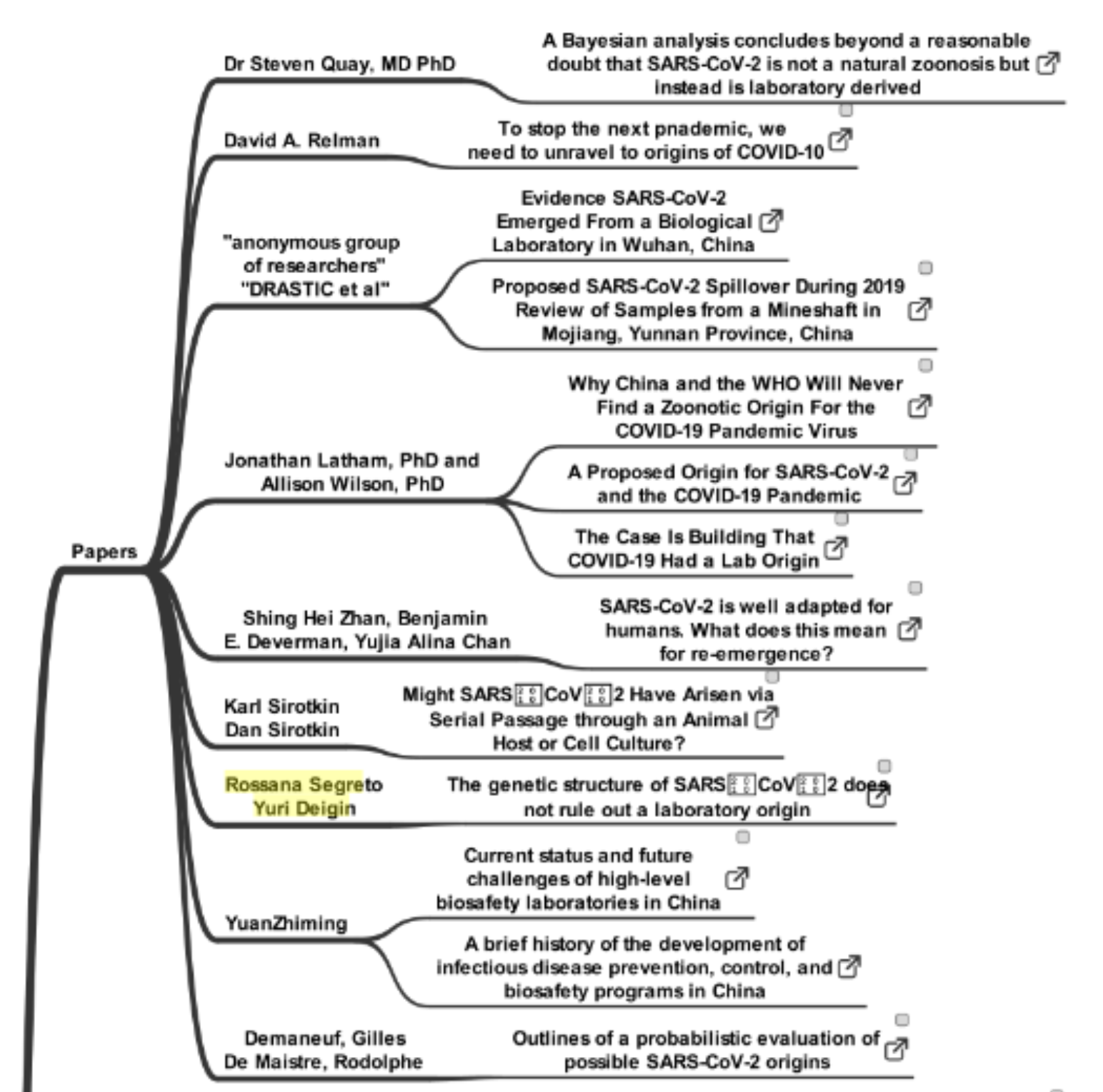
How Serious Were Government Investigations of COVID-19 Origin?
According to Christopher Ford, this embrace of fringe internet theories flowed from top-down political pressure, with a secretive investigation into the lab leak theory, trying to build a case around biological weapons. When actual scientists finally reviewed the work, it fell flat. The media continues to hype anecdotes of elements of the intelligence community favoring lab leak, but details of the actual investigations that trickle out always lack a solid argument and often, as with Chretien's interview, center on theories proven false long ago.
How many other agencies produced analysis as counterproductive as the NCMI working paper? Hopefully the answer is "not many" and hopefully the relevant information is published so everyone can know. But, we do know that Jason Bannan, a former FBI senior scientist, was a driving force behind the FBI's assessment that a lab leak was likely. Speaking recently at a Brookings Institution event, Bannan criticized the intelligence community's review for failing to include public health experts like clinicians and epidemiologists. However, Bannan noted one exception, singling out the NCMI for praise because they did have such expertise.
Is it true that the most qualified people on the case were the ones copy-pasting "intelligence" from internet conspiracy theorists? I doubt it. Yet, this inept sort of analysis has regularly caught the attention of journalists and politicians for years.
If the NIH has avoided hosting the worst of this type of analysis so far, that will probably end today with Ridley's lecture. Tune in to find out.
Or check out the counter-programming from Rasmussen, Andersen, and Gronvall.
Stay tuned for:
Robert Kadlec's Half-Billion-Dollar Air Conditioner