Matt Ridley's Trial by Comment
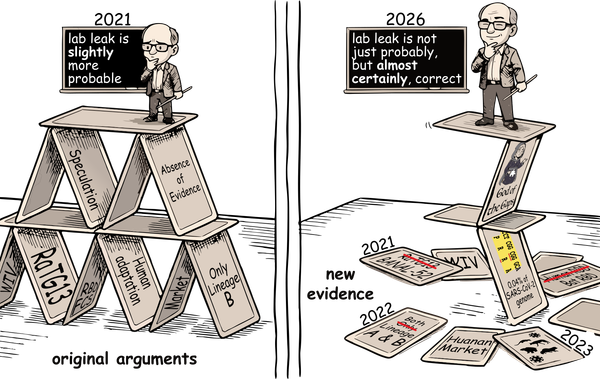
My last post laid out the absurdity of Matt Ridley going from declaring that the Wuhan Institute of Virology was "almost certainly the wrong lab to look at" to recently telling an audience at the NIH "that it was not just probably, but almost certainly, correct" that the COVID-19 pandemic started as a lab leak at the Wuhan Institute of Virology. A change of heart that makes little sense since evidence piled up against a lab origin in the interim.
Rather than respond respond directly, Ridley has nominated a champion to argue on his behalf, environmental microbiologist Monali Rahalkar. Unfortunately, Rahalkar has less credibility on this subject than Ridley himself, and the arguments she offers in his defense are false.
Rahalkar's claim to fame is a paper in which she attributed 2012 illnesses described in a 2013 Masters thesis to COVID-19. This conclusion was panned by a group of authors with relevant expertise:
"The laboratory leak theory is essentially based on a publication by Rahalkar and Bahulikar in 2020 linking SARS-CoV-2 to the Mojiang mine incident in 2012 during which six miners fell sick and three died. We analyzed the clinical reports. The diagnosis is not that of COVID-19 or SARS. SARS-CoV-2 was not present in the Mojiang mine."
Regardless, Rahalkar concluded that she "cannot say that RaTG13 or SARS-CoV-2 infected the miners, there is a high chance that it could be a virus quite similar in genetic composition to these two." As I detailed in a previous post, we can say with 100% certainty that SARS-CoV-2 did not cause these illnesses, thanks to work by scientists from independent teams on bat viruses found in "China, Vietnam, Cambodia, Laos, Japan, and even in Gloucestershire in South West England."
Specifically, Rahalkar claims that, contrary to all of the published evidence, a virus sampled by the Wuhan Institute of Virology, RaTG13, is still suspicious, and that the SARS-CoV-2 receptor binding domain (RBD) lacks any explanation in nature:
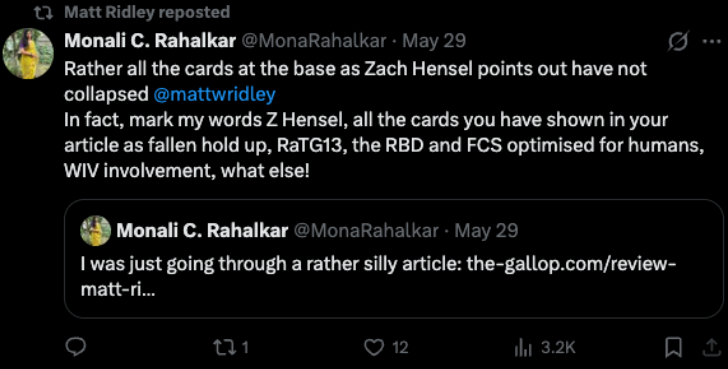
Rahalkar's insistence that the RBD is suspicious is at odds with this statement in the paper that definitively proved that this was not the case:
"With the new viruses described here, understanding the emergence of SARS-CoV-2 does not require speculation of recombination or natural selection for increased RBD affinity for hACE2 in an intermediate host such as the pangolin before spillover, nor natural selection in humans following spillover."
How can Rahalkar square these two irreconcilable statements? It's easier than you think; the trick is just to say that all of the contradictory evidence is fake:
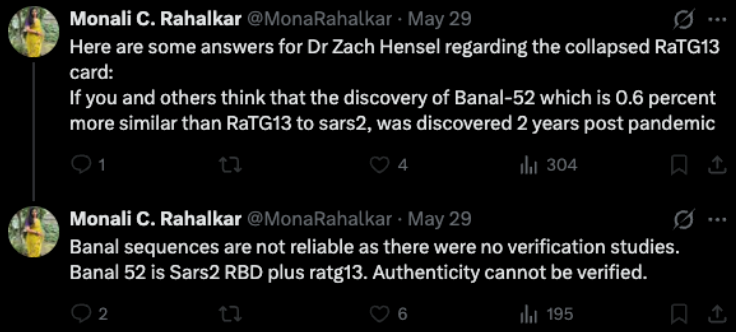
Of course, the authenticity of BANAL-52 can be easily verified. For one, it's perfectly consistent with the diversity of bat coronavirus genomes published before and since. What's more, BANAL-52 was synthesized and grown in a lab, so it's obviously an authentic viral genome.
I contacted Matt Ridley by email about these new errors, and I did not receive a response. Instead, he took to X to stand behind his champion again, who this time is saying, erroneously, that the Wuhan Institute of Virology withheld publication of sequences as part of some sort of preemptive cover-up:
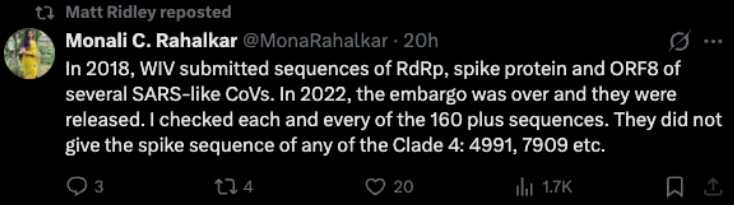
The reality here is quite boring. First, Rahalkar is wrong: several of the sequences she said were hidden were submitted to GenBank (for example, "7909" is this one). Second, the lack of a sequence for RaTG13 (aka 4991) is simple to explain: the PCR primers used didn't work for the then-unknown virus. For one primer, 6 out of 20 bases do not match! The expectation here is not obtaining a sequence, and that's what happened.

I hope that Ridley and Rahalkar will correct the record and apologize to the people they've defamed with these inane conspiracy theories.