Review: Matt Ridley's "Viral" Case for a Lab Leak
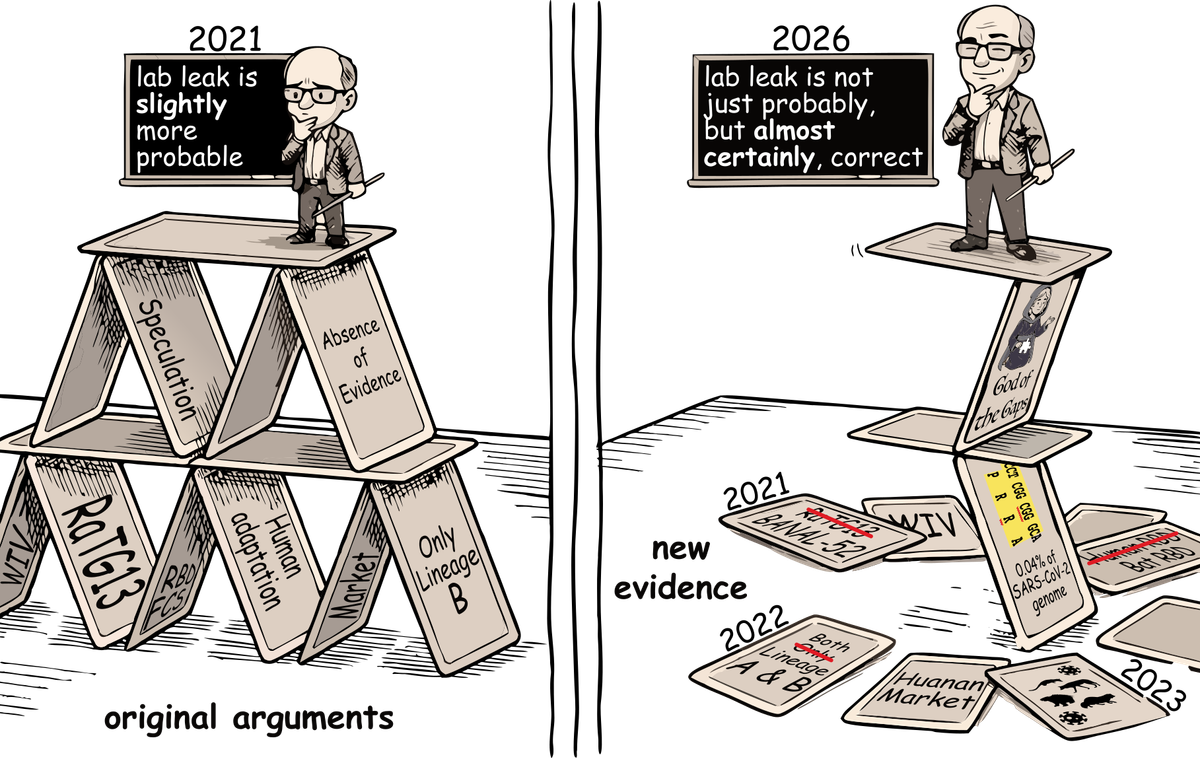
Matt Ridley went from calling a lab leak “slightly more probable” in 2021 to “almost certainly correct” in 2026. Yet, as his original case in Viral collapsed, his certainty now rests on a 12-nucleotide "God of the Gaps."
Update: Regarding the response from Matt Ridley
On March 20, 2026, Matt Ridley gave the inaugural NIH Scientific Freedom Lecture. His topic: explaining how he "went from dismissing the lab leak hypothesis to concluding that it was not just probably, but almost certainly, correct."
Florence Débarre has serialized a point-by-point review documenting falsehoods and deception in Ridley’s lecture. She published a transcript as well. My review is going to be very different.
"Now, I’m often asked, 'If you think you all this is important, why haven’t you published it in the peer-reviewed literature?' Believe me, we’ve tried." — Matt Ridley
“I don’t spend much time trying to publish things in the peer-reviewed literature.” — also Matt Ridley
Before Ridley's lecture, I’d guessed that Ridley would avoid talking about a particular lab leak theory that he had embraced in mid-2020, and that was definitively disproven in September 2021—the theory that SARS-CoV-2 was engineered by combining a backbone from a bat virus with a Spike receptor binding domain from a pangolin virus. And he avoided it.
By mid-2020 Ridley had either forgotten about this contradictory evidence, or had decided to stop mentioning it.
What I didn’t know at the time was that Ridley, in his first commentary on the subject in the Wall Street Journal, had demonstrated a decent understanding of the research that showed why this theory was unsound to begin with:
"The role of pangolins in the spread of Sars-CoV-2, the virus that causes Covid-19, remains unclear. A closer look at more of the Sars-CoV-2 genome, published last week by Maciej Boni at Penn State University and David Robertson at Glasgow University, together with Chinese and European colleagues, finds that human versions of the virus are more closely related to the RaTG13 horseshoe bat sample from the cave than they are to the known pangolin versions. It is not yet possible to tell whether the virus went from bat to pangolin to people, or from bat to pangolin and bat to people in parallel."
Just a few days later, Ridley had become more curious about a lab origin, but wrote of the Wuhan Institute of Virology: “this is almost certainly the wrong lab to look at” since it wasn’t located near early COVID-19 cases.
But, by mid-2020 Ridley had either forgotten about this contradictory data, or had decided to stop mentioning it. Ridley started borrowing material from one of his Twitter muses, anti-aging startup hype man Yuri Deigin, writing of how SARS-CoV-2 “has a backbone very like a known bat virus and a spike gene v like a known pangolin strain.” In their book Viral, Ridley and co-author Alina Chan leaned on Deigin’s theory to claim there was something “unsettling” about similarity between SARS-CoV-2 and a pangolin coronavirus. The paper from Boni et al. that threw cold water on Deigin’s theory and first interested Ridley in the origins topic was never mentioned in Viral.
Even after the never-sound theory was definitively proven wrong, Ridley stuck with a garbled version of it, writing that SARS-CoV-2 “looks like a (re?)combination of” components from: (1) a single Chinese county, (2) the country of Laos (or maybe a pangolin from elsewhere), and (3) “somewhere.” However, Ridley was still on the fence, concluding that “both options are still on the table, lab based and natural.”
Now, four and a half years later, Ridley says that the “lab based” option is “not just probably, but almost certainly, correct.” What changed?
The Speculative Mr. Ridley
There’s another thing Ridley is certain about in his lecture: his work is very serious, and his attempts to publish are being unjustly “turned down by gatekeeping referees.” Yet, when pressed for details after his lecture, he provided a damning contradiction: “I don’t spend much time trying to publish things in the peer-reviewed literature.” He is not gatekept; he is simply uninterested in peer review.
At his lecture, Ridley gave two examples, one of which he’d teased in The Telegraph and then published there as “the Covid Paper they don’t want you to read.”
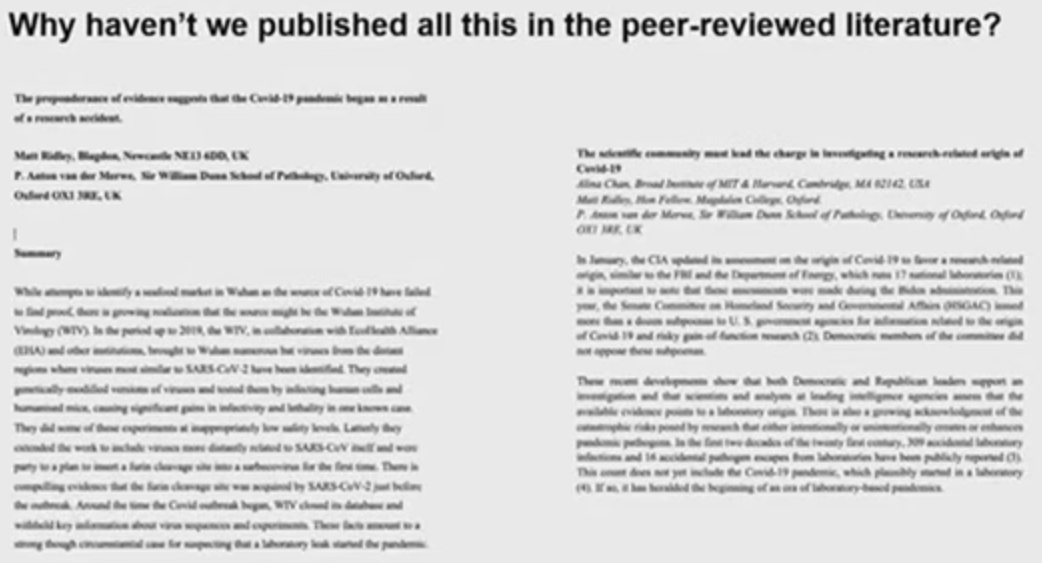
One paper, Ridley says, was an invited submission, a sort-of review rejected by one journal, and rejected once more when Ridley tried again elsewhere. He did not try very hard.
A peer reviewer that values his or her time would recommend rejection on this basis alone.
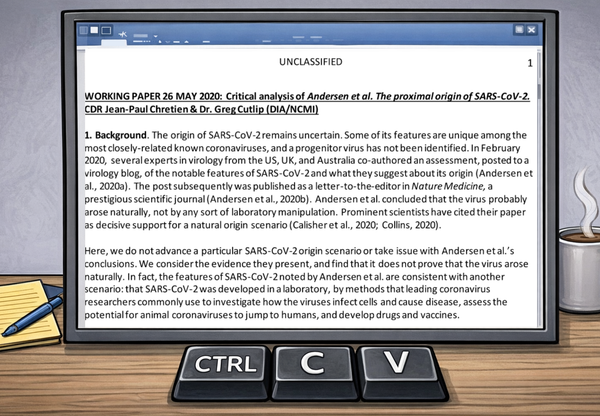
The single figure in the manuscript is uninteresting and duplicative of many published elsewhere. Ridley's version is a screenshot of a sequence alignment from a word processing program, decorated by a blinking cursor and spell check artifacts.
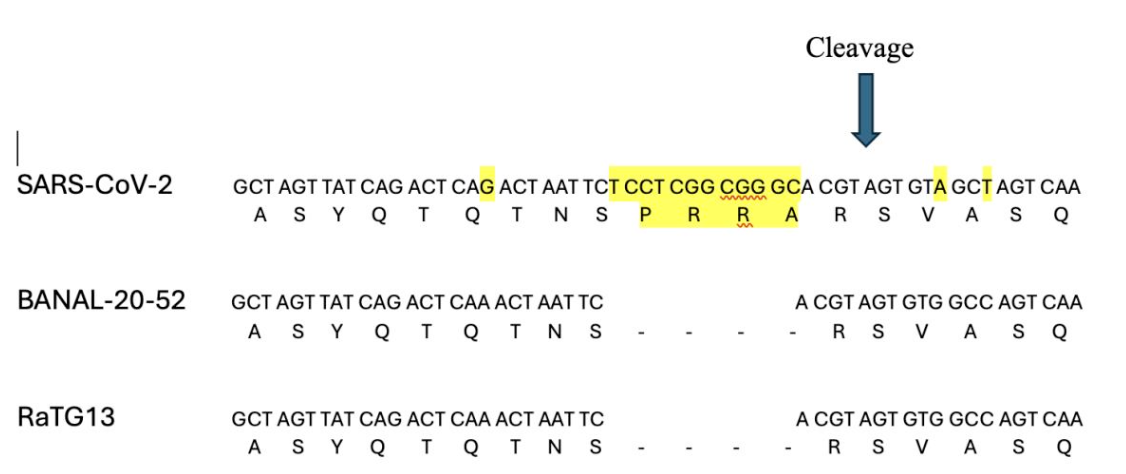
The point this figure is claimed to support—that it is clear from visual examination that 12 nucleotides distinguishing SARS-CoV-2 from two closely related viruses occurred in a single evolutionary step—is false. The fact that three other nucleotides in its vicinity also differ shows that the common ancestor of the three sequences likely existed much too long ago to draw this conclusion. A peer reviewer that values his or her time would recommend rejection on this basis alone.
The 12-Nucleotide "God of the Gaps" Argument
It’s not an overstatement to say that Ridley’s scientific case begins and ends with those specific 12 nucleotides that, along with a couple hundred others, separate SARS-CoV-2 from the most closely related viruses found in bats. This argument to ignorance—Ridley’s “God of the Gaps”—is the sort of thing that is an immediate red flag to a skeptical scientific audience. Ridley’s decision to make such a flimsy argument to an audience at the NIH speaks to how confident he was that he’d be shielded from any real criticism. That confidence was not misplaced. NIH Director Jay Bhattacharya, who promoted lab origins of not just COVID-19 but also HIV, Ebola, and Lyme disease, moderated the event. Bhattacharya regularly stepped in to redirect pointed questions and even took the liberty of answering on his behalf.
The conclusion of Ridley’s paper inaccurately describes work in a 2018 research proposal that was unfunded and, nonetheless, proposed to take place in North Carolina. His conclusion of a lab leak origin rests on this premise:
"The surprising failure to find better evidence for a natural spillover, and the lack of transparency from the Chinese scientists, is therefore best explained by positing a laboratory accident involving a live virus experiment as the cause of the Covid pandemic and attempts to cover it up."
This is a textbook argument to ignorance. To base a case on a partial gap in evidence for a natural origin while simultaneously providing zero evidence for a lab origin, and then blaming that lack of evidence on unsubstantiated “attempts to cover it up,” is fundamentally flawed and undermines his entire case.
The singularly surprising thing about Ridley’s story is that he says he received reviews at all, rather than a blunt desk rejection.
The other paper, based on what Ridley showed at his talk (it is not published elsewhere) is not a scientific paper at all. It’s some sort of call-to-arms titled, “The scientific community must lead the charge in investigating a research-related origin of Covid-19.” Unfortunately for Ridley and his co-authors Alina Chan & Anton van der Merwe, this isn’t the sort of thing that is peer reviewed at all.
Titles of nobility don’t confer the same ability to bulldoze your way into scientific journals that they apparently do in The Telegraph.
Peerage review
Matthew White Ridley, 5th Viscount Ridley, is the eighth of his name in the lineage of Blagdon Estate owners started by the marriage of Elizabeth White to her first cousin Matthew Ridley. With the exception of 4th Baronet Ridley, whose subpar record the family attributes to a life “made difficult by a long feud between his many siblings and his domineering mother,” the family’s parallel legacies are business and politics.
When it comes to COVID-19 origins, Ridley’s rhetoric maintains those family traditions—popular and political impact are prioritized over factual accuracy and sound logic. Criticism is only acknowledged and addressed if ignoring it means a loss of face in the circles in which Ridley is influential.
Ridley Ignored Hiltzik's Critique
Take Michael Hiltzik’s brutal review of Viral in the LA Times as an example—criticism Ridley ignored. According to Hiltzik, “what Chan and Ridley have done is place a conspiracy theory between hardcovers to masquerade as sober scientific inquiry.” He pinpointed the slippery discussion of that 12-nucleotide “God of the Gaps,” the furin cleavage site. Ridley and co-author Alina Chan had written:
“Sure, if the furin cleavage site proves to have been inserted artificially, it confirms that the virus was in a laboratory and was altered. But if, on the other hand, the furin cleavage site proves to be natural, it still says nothing about where the virus came from.”
Hiltzik got straight to the point: “Why write about it at all, then?” He also criticized the insincere fence-sitting in Viral when it came to the question of whether or not COVID-19 emerged naturally: “the authors don’t even emerge with the courage of their own convictions.”
Hiltzik’s characterization was accurate: while promoting his Fall 2021 book Viral, Matt Ridley said of himself and co-author Alina Chan, “we’ve come to the conclusion that the lab leak is slightly more probable.” Now, in his talk, Ridley has upgraded from slightly to “almost certainly, correct.” What changed?
Contradictory Evidence Deleted from Viral's Second Edition
Did Ridley’s increased confidence today come from an accumulation of supporting evidence in favor of a lab origin of SARS-CoV-2? It does not. Quite the opposite.
“Would proposing that a lab #OriginOfCovid is the most likely origin make the book less scientific but more impactful?” — Alina Chan discussing editing Viral for the paperback edition.
As I explained to Andrew Sullivan:
“You should check out the stuff Alina Chan and Matt Ridley deleted from Viral — their lab leak book — between editions when it was no longer true.”
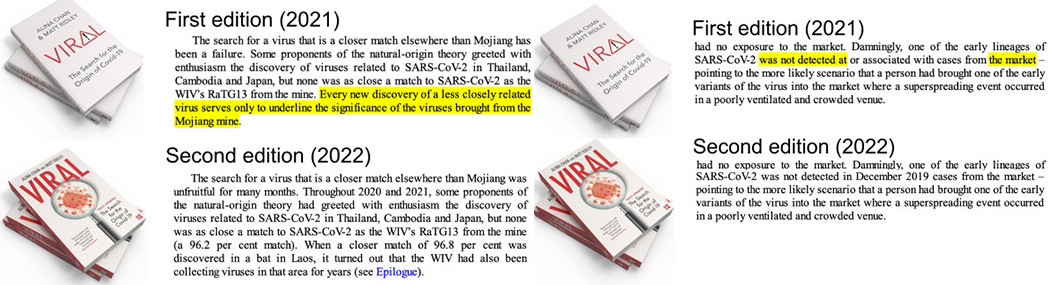
I gave two examples of how key arguments in Viral had been negated by new evidence, and how Chan and Ridley simply deleted them from the book in response without changing their conclusions.
These deletions included arguments about the significance of the singular association between the Wuhan Institute of Virology and the most closely related bat virus to SARS-CoV-2, and the claim that the second early lineage of SARS-CoV-2 was "not detected at" the Huanan market.
In another example, Chan and Ridley argued that the burden of proof lay with the Wuhan Institute of Virology (WIV) to disprove a lab leak origin, since a lab there had sampled RaTG13, the virus with the most similar genome to SARS-CoV-2 as of mid-2021 (NB: most similar, but not remotely similar enough for this argument to make sense). The burden of proof didn’t shift again when this was no longer the case after BANAL-52 was sampled in Laos. Instead, the fact that samples were collected just across the border from Yunnan province in Laos meant that WIV researchers were working in the same “remote regions.” It’s unclear whether or not Chan and Ridley are aware that BANAL-52 was sampled outside of Vientiane, hundreds of kilometers from where WIV had worked.
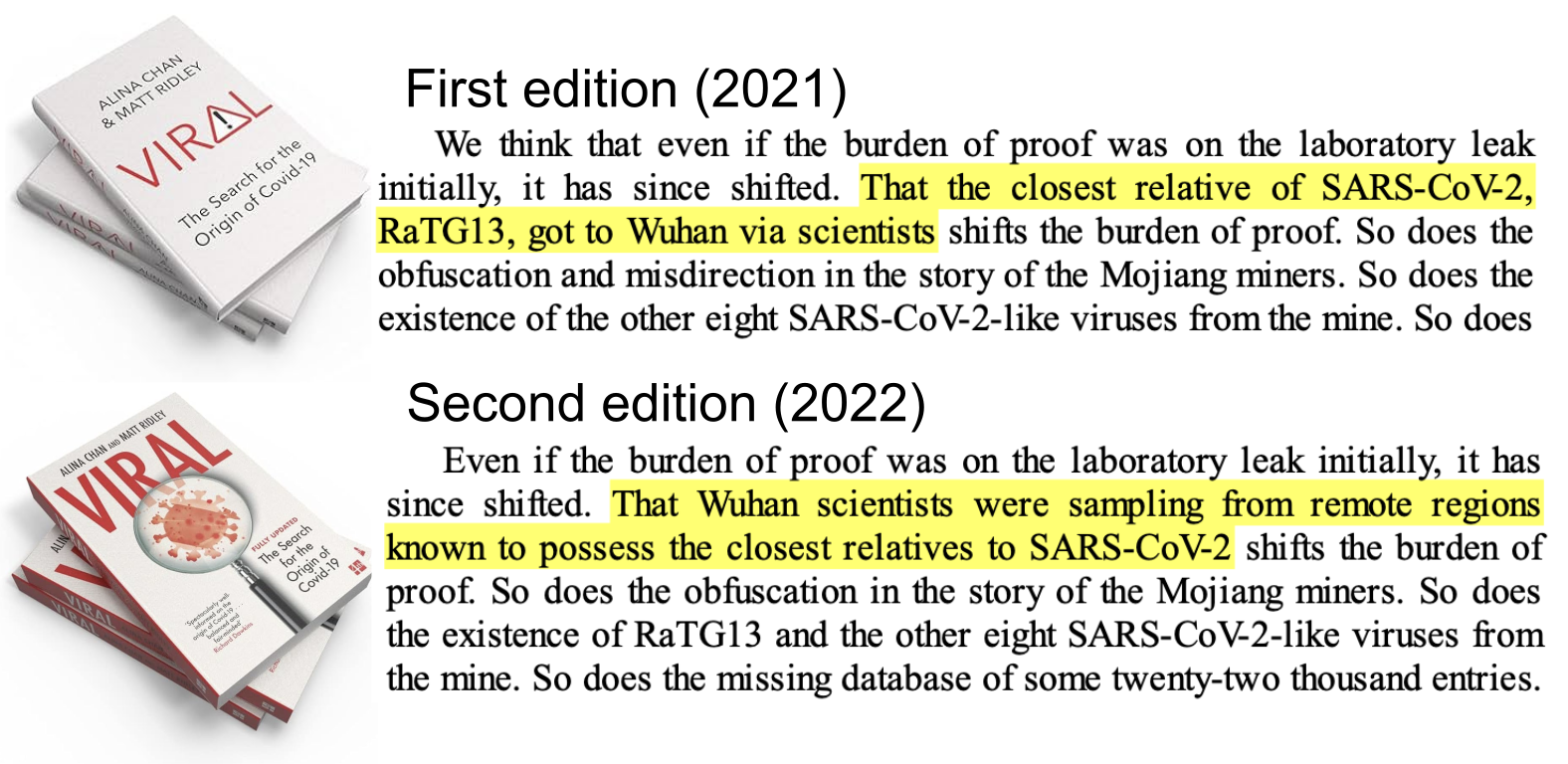
In retrospect, these kinds of edits aren’t surprising. After all, during the editing process, co-author Alina Chan asked: “Would proposing that a lab #OriginOfCovid is the most likely origin make the book less scientific but more impactful?”
The Sources Ridley Defends
Unlike Hiltzik’s review, my comments drew immediate protest from Ridley. “An outrageous defamation,” he called it. He goes on to give zero examples of anything I said that was wrong, let alone defamatory. Ridley also made a few new mistakes, but rather than follow him down that rabbit hole, let’s look at what Sullivan wrote that Ridley was just fine with:
"Here is the MI6 document from early 2020 arguing that a lab leak was 'beyond reasonable doubt.' The German BND says the same. Ditto the DIA."
The context of Sullivan’s quoted “beyond reasonable doubt” is a wild summary that also says that vaccine design is doomed since “COVID-19 was engineered” and that the journal Nature is a propaganda arm of the PRC.
Ridley was fine with Sullivan appealing to such questionable authorities and getting the facts wrong. The only association of that “MI6 document” with MI6 is one co-author being Richard Dearlove, who’s been out of MI6 for two decades and was last responsible for overseeing intelligence failures in the lead up to the Iraq war. Ridley knows this is wrong, having attributed it to “the former head of MI6” in the Daily Mail. Ridley doesn’t note the mistakes that led to Dearlove’s early retirement.
Dearlove’s most colorful mistake: sticking with claims from a source despite “the source’s description of the device and its spherical glass contents was remarkably similar to the fictional chemical weapon portrayed in the film The Rock.” In addition to their very strange lab leak document, Dearlove and company were also pitching a movie, The COVID Hunters: In Pursuit of the Chimera and the Vaccine. In their film treatment, pitched to a producer of Contagion, the “COVID Hunters” explain that SARS-CoV-2 was engineered to be “preferentially pathogenic to black people,” and that evidence of this will be found in North Carolina of all places. They also wrote that two scientists who suspected a lab origin must’ve died or disappeared; in fact, one of those scientists was alive and well when contacted by The Wall Street Journal.
Why Ridley Responds to Andrew Sullivan
While Matt Ridley ignores criticism from scientists and journalists like Michael Hiltzik, things change when the critique comes from a fellow member of the conservative elite like Andrew Sullivan. The two share a background as alumni of Oxford's Magdalen College from the same era, and Sullivan is influential in the political and media spheres Ridley seeks to sway.
Ridley's concern for accuracy on Sullivan's platform is selective. Ridley bristled at factual corrections regarding Viral, but he was fine with Sullivan repeating demonstrably false claims that favored the lab leak narrative.
This selectivity follows the pattern in Ridley’s six years of lab leak commentary: disinterest in factual accuracy or logical consistency. Instead, the priority is political effect. What Ridley wants is "peerage review", maintaining influence within high-status circles—rather than scientific peer review. Ridley got an apology from Sullivan and a chance to rehash his hand-waving arguments why contradictory evidence must be ignored.
It doesn’t matter to Ridley that the lab leak hypothesis offered by Dearlove and company is the same one that Ridley argued against in the Wall Street Journal and that was definitively disproven in September 2021. Ridley is happy to go on TV now and say that there was some sort of cover up inside 10 Downing Street when, in reality, bad ideas were easily dismissed as bad ideas. And this wasn't suppressed behind the scenes; Dearlove and his colleagues made their case publicly in mid-2020 and it was rejected because it was ridiculous.
Nothing New
So, what is the additional evidence that brought Ridley from saying that the Wuhan Institute of Virology was “almost certainly the wrong lab to look at” to claiming that a lab leak origin was “almost certainly correct?” As Florence Débarre’s thorough review details, the answer is: nothing.
If you ask Ridley what made him change his mind, he’ll say it’s an unfunded research proposal called DEFUSE. Nope. That proposal was described at length in the first edition of Viral, back when Ridley was on the fence ("slightly more probable") about whether SARS-CoV-2 emerged naturally or in a lab.
In reality, evidence since Viral only moved in one direction—in support of a natural origin. Viral was even edited between its hardcover and paperback editions to tweak sentences that had once relied on gaps in evidence that have since been filled.
There were three pillars of the Fall 2021 lab leak argument in Viral, all hinging on absences of evidence:
- No one had found an animal virus more similar to SARS-CoV-2 than one found by a lab in Wuhan.
- Only one of two early SARS-CoV-2 lineages was associated with the Wuhan wildlife market where early COVID-19 cases were detected.
- Some molecular features of SARS-CoV-2 such as strongly binding the human Ace2 receptor and a 12-nucleotide insert that conferred a protease cleavage site had not been found in natural viruses.
Now, all that’s left of that is a 12-nucleotide “God of the Gaps.”
A specific error that’s persisted for years from Viral through Ridley’s lecture will be a topic for another post. I have already contacted Ridley and his co-authors and requested that they correct the record. This error has misled scientific colleagues, journalists, and even a US government investigation. So far, no one has responded.